

From the Kitchen Table to Action
Military family life continues to change from one generation to the next, but many of the conversations happening around kitchen tables today sound remarkably similar. Families are still talking about childcare access, financial pressures, military spouse employment, and the barriers that can make it difficult to find the support they need.
Those realities were at the center of NMFA’s annual State of the Military Family® Summit, which brought together researchers, military family advocates, educators, nonprofit leaders, and members of the military community to examine what families are experiencing today and what we can do about it.
What Military Kids Are Telling Us
The conversation began by focusing on military children and the experiences of some of the youngest members of our community.
Dr. Walter S. Gilliam, Executive Director of the Buffett Early Childhood Institute, shared research examining the experiences of young military children and the people who care for them. His research reinforced something military families have long understood: the effects of military life can begin early, and supporting children also means strengthening the adults and systems around them.
From there, the conversation followed military kids as they grow.
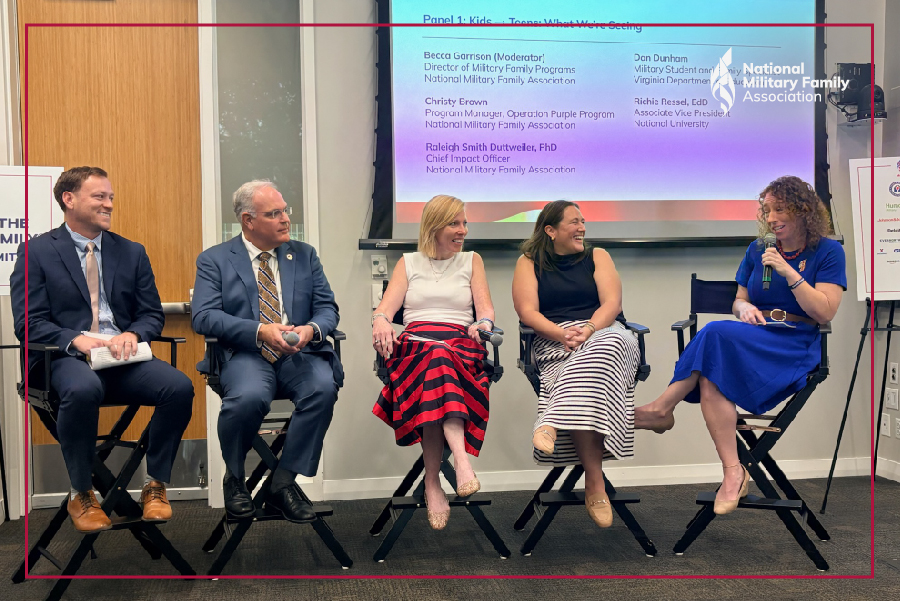
Leaders from NMFA, the Virginia Department of Education, and National University explored what they are seeing among school-age children and teens. Their discussion drew on experiences from Operation Purple® Camp, NMFA’s teen research, classrooms, and school communities.
The discussion highlighted the importance of listening directly to young people, building strong peer connections, and making sure support is available during transition periods, such as a PCS move or entering yet another new school.
Turning Military Family Experience Into Action
Listening is where the work really begins. A second panel brought together military spouses and advocates who have taken challenges they have seen and experienced in their own communities and turned them into action. Their work spans childcare, spouse employment, financial well-being, food insecurity, support for military and veteran children, and policy change. Their experiences reinforced a central theme: military families should have a voice in shaping the solutions intended to support them.
The conversation also explored what effective advocacy looks like today and how personal stories, paired with data, can help decision-makers better understand where families are struggling and what meaningful solutions could look like.
The Kitchen-Table Conversation Continues
The day came full circle with a conversation between NMFA CEO Besa Tafilaj Pinchotti and longtime NMFA leader and former Executive Director Joyce Raezer.
Looking back on decades of advocacy, they reflected on what military families needed during years of war and repeated deployments, what has changed since then, and where families need advocates to show up next.
“Advocates in this space have to be fierce for the families they serve,” said Raezer. “Military families are still facing the same problems they were decades ago.”
Nearly 60 years after our founding mothers first gathered around a kitchen table and created what would become NMFA, the work still begins in much the same way: by listening to military families.
What comes next depends on what we do with what we hear.
When families, advocates, researchers, schools, nonprofits, employers, funders, and decision-makers bring their strengths to the same table, we can move beyond identifying the challenges military families face and build solutions grounded in what families actually experience.
Together, We’re Stronger®
SHARE YOUR STORY
CATEGORIES:
TAGS: